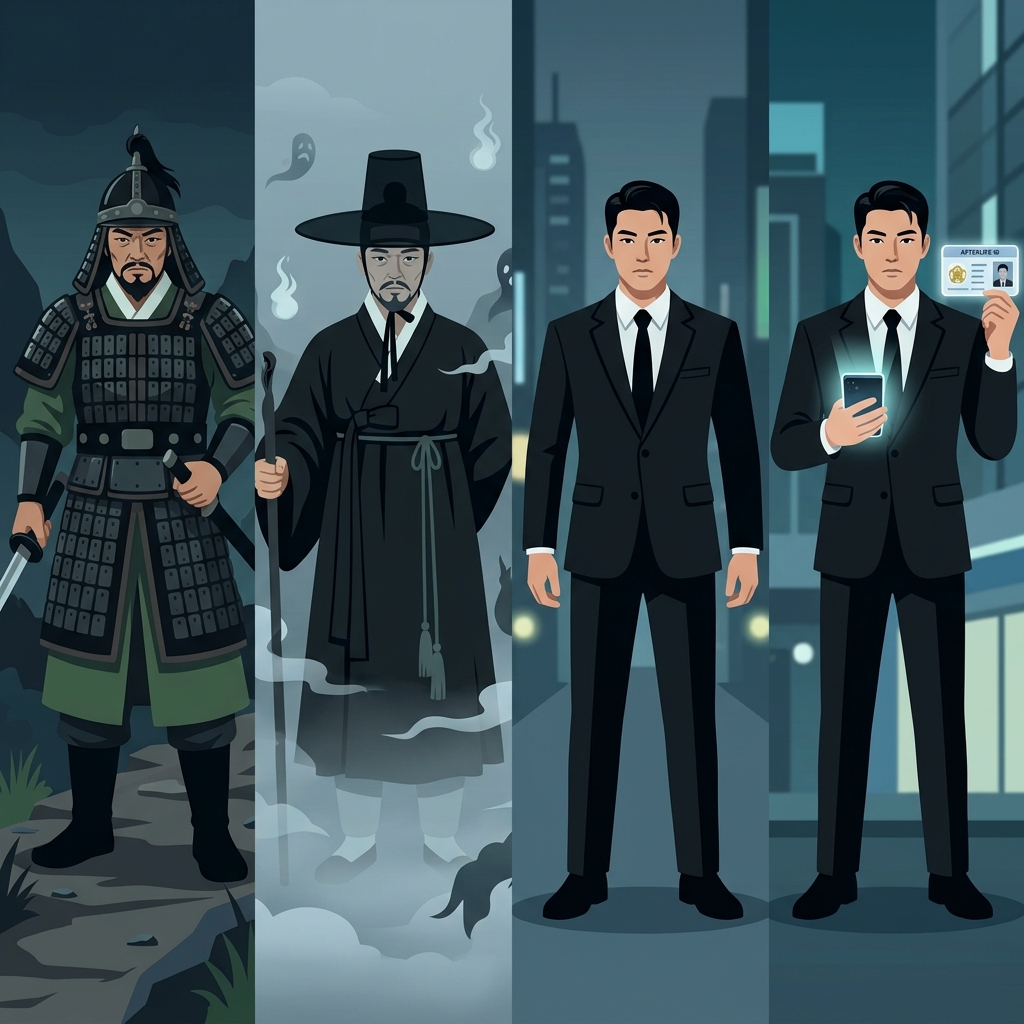

The Korean Death Messenger, or ‘Jeoseung Saja,’ is not a fixed icon of terror but a mirror reflecting the changes of the times.
Did you know that the image of the Grim Reaper we see in webtoons today is the result of a precise historical and cultural evolution.
In the oldest records, the messengers of the afterlife were not clad in black robes but were depicted as military officers in vibrant armor.
They were powerful commanders of the netherworld, serving as the dignified enforcers of King Yama’s divine law.
It wasn’t until the 1980s that the iconic image of the ‘pale face in a black robe and hat’ became standardized through Korean television media.
From this period, the messenger became an object of fear appearing in the fog, a messenger of an irresistible and dark fate.
In modern times, they have transformed once again into cold, professional agents wearing sleek black suits.
This reflects a modern projection of death as a professional service rather than an emotional tragedy, handled with cold efficiency.
Recent webtoons take this a step further, depicting them as ‘Afterlife Salarymen’ holding smartphones and ID cards.
The sight of them checking souls through apps and worrying about their performance reviews is a unique satire of modern life.
For Koreans, the afterlife is no longer a mystery of pure terror but is perceived as another vast system resembling the world of the living.
The evolution from a warrior to a messenger, and from an agent to a salaryman, symbolizes how the perception of death has shifted over generations.
Through this fascinating evolutionary process, we can see the unique depth of the world-building found in Korean webtoons.