
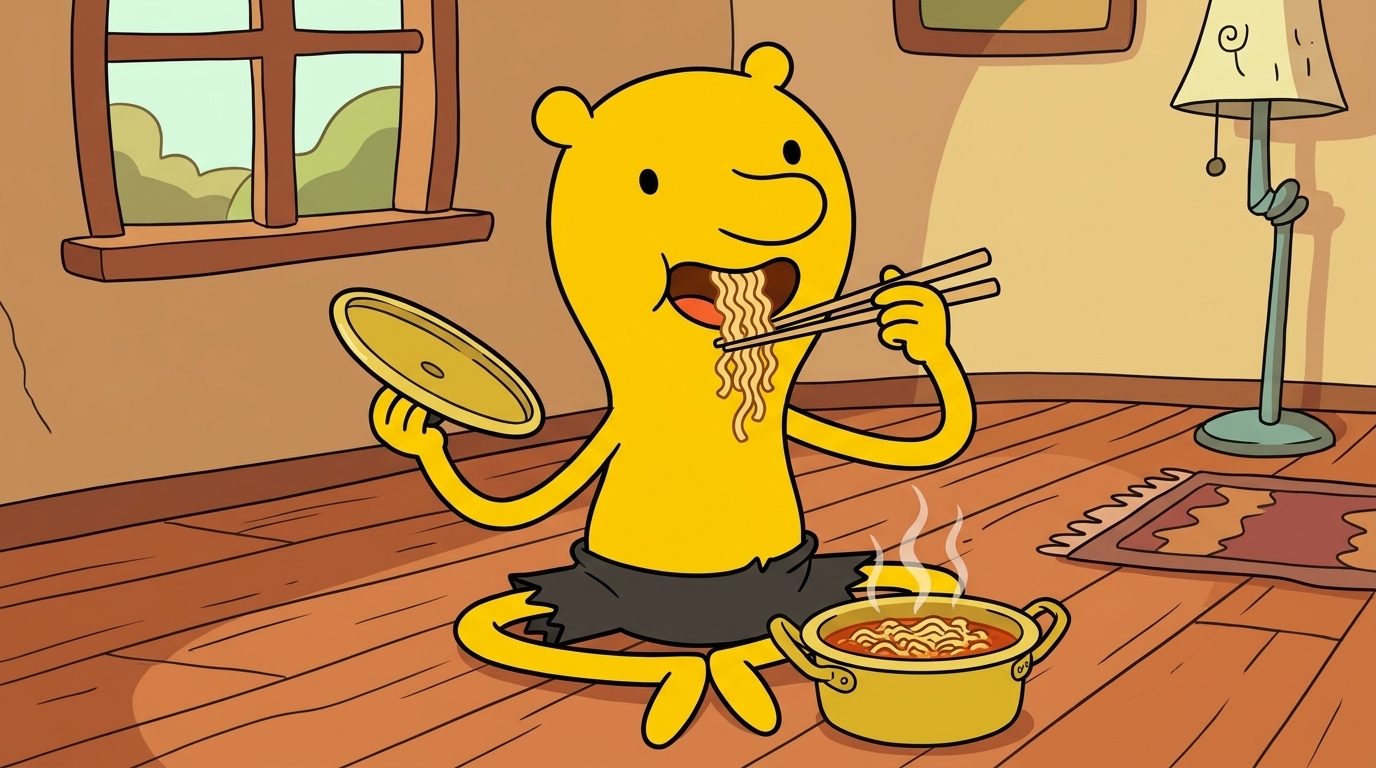
If you wonder what the phrase do you want to eat ramyeon kdrama meaning really signifies, it serves as South Korea’s subtle equivalent of Netflix and chill. In a society influenced by Confucianism and Christianity where direct sexual propositions are taboo, suggesting instant noodles offers an innocent excuse to invite someone inside while protecting both parties from awkward rejection.
1. Where Did “Do You Want to Eat Ramyeon?” Come From?
International viewers bingeing K-dramas on Netflix often encounter a puzzling late-night moment: just before parting at the doorstep, one character turns around and asks with hesitation, “Do you want to eat ramyeon before you go?” If you take that line literally as a polite invitation for a midnight snack, you miss the intense romantic friction and subtle sexual tension vibrating through the scene.
The cinematic origin of this legendary phrase traces back to director Hur Jin-ho’s acclaimed 2001 romantic film One Fine Spring Day. After finishing late-night sound recording in Gangneung, radio producer Eun-soo (played by Lee Young-ae) drops off sound engineer Sang-woo (Yoo Ji-tae) outside her apartment and nonchalantly asks, “Do you want to eat ramyeon?” Interestingly, the original shooting script called for the mundane line, “Do you want a cup of coffee?” On set, the director and actress decided coffee felt too generic, improvising the substitution of humble instant noodles—and inadvertently crafting one of the most famous pick-up lines in Korean pop culture history.
The cultural psychology behind this line is deeply rooted in Korean social dynamics. Shaped by enduring Confucian ethics and modern Christian influences, Korean society has historically maintained conservative attitudes toward public expressions of physical intimacy. Directly asking someone, “Do you want to spend the night at my place?” carries an intense social stigma that few people would dare say out loud.
💡 The Cultural Psychology of the “Ramen Excuse”
In South Korea, conservative decorum long made forward sexual invitations culturally unacceptable. “Do you want to eat ramyeon?” provided the ideal psychological armor: if the other person declined by saying it was too late, the inviter could save face effortlessly by replying, “I was honestly just hungry for noodles.” It offered romance with zero risk of embarrassment.
Instant noodles solved this dilemma brilliantly. Ramyeon is affordable, universally available in every pantry, and ready in three minutes. If the other person turns down the offer by saying it is too late, the speaker can effortlessly preserve their dignity by brushing it off: “I was just hungry and thought we could share a quick bowl.” It created an unspoken invitation wrapped in a protective emotional shield.
2. Why Do K-Drama Characters Slurp Ramyeon from Pot Lids at Midnight?
In countless K-dramas, you will see leads boiling ramyeon past midnight in battered yellow nickel-silver pots (known as yang-eun naembi), flipping the pot lid upside down to use as a makeshift plate. Why has this instant dish evolved into Korea’s quintessential comfort food?
South Korea ranks among the highest per-capita instant noodle consumers in the world. But for Koreans, ramyeon is far more than convenient junk food; it is an emotional touchstone intertwined with modern history. In the difficult decades following the Korean War, food shortages were widespread. When instant ramyeon debuted in the 1960s, it served as an essential national relief ration. The South Korean government actively spearheaded nationwide campaigns encouraging citizens to consume wheat flour and noodles instead of scarce domestic rice.
💡 Ramyeon Was a Matter of National Survival
To Koreans, instant noodles are not junk food; they are a poignant piece of living history. In the impoverished 1960s, the government actively encouraged ramyeon consumption and even mandated that manufacturers fortify packets with essential vitamins and calcium so workers would not succumb to malnutrition. Even today, ramyeon prices are closely watched and controlled by the state as a critical livelihood indicator.
To prevent impoverished citizens who relied on ramyeon for daily sustenance from suffering malnutrition, the government and manufacturers worked together to fortify noodle dough with vital nutrients like calcium and vitamin B. Even today, the price of ramyeon remains heavily monitored by state regulators as a vital barometer of national consumer welfare. A single bowl of noodles carries the memory of resilience through lean times.
This survival history shaped unique everyday dining habits. The thin yellow brass pot heats up in seconds to cook noodles with maximum springiness. Using the pot lid as a dish cools boiling-hot noodles instantly while sparing busy students and single workers from washing extra bowls. What began as practical necessity has transformed into an iconic visual cliché across modern television dramas.
3. Korea’s Extreme Noodle Passion and the Cold Reality of “Ramyeon and Chill”
Korea’s romance with instant noodles runs remarkably deep. In a fast-paced society famous for its “Ppalli-ppalli” (quick, quick) efficiency, an entire hot meal cooked from a single packet in three minutes is woven into everyone’s upbringing. Koreans have even engineered specialized automated dispensers along the Han River parks that boil foil bowls of instant noodles with computer-calibrated water and cook times.
Furthermore, Koreans treat ramyeon seasoning powder as a culinary miracle cure. If home cooking falls flat or a traditional stew tastes bland, a spoonful of noodle seasoning instantly rescues the broth. Popularized across hit variety shows like Family Outing, locals half-jokingly defend the practice: “Why wouldn’t it taste delicious when Korea’s elite food scientists with master’s degrees spent decades perfecting the formula?”
However, international travelers should take note of a crucial cultural warning before adopting K-drama lines in real life. Using “Do you want to eat ramyeon?” casually in South Korea can easily trigger serious misunderstandings.
Because the phrase carries heavy sexual connotations, Koreans never use it when they genuinely respect someone or wish to build a serious relationship. If someone you just met asks you out of nowhere to come over for ramyeon, it is not a heartwarming confession; it is often a significant red flag indicating that they view you as a casual, low-effort encounter. Among today’s 20- and 30-somethings, the phrase has largely become a satirical joke shared among friends rather than an actual courtship ritual.
4. Moving Past K-Drama Fantasy: How to Experience True Korean Ramyeon
Behind the simple query “Do you want to eat ramyeon?” lies an intricate tapestry of Confucian propriety, romantic vulnerability, fear of social rejection, and the enduring heritage of a nation’s staple comfort food.
While the secretive smiles and simmering romance on screen are delightful to watch, real-life courtship in Seoul follows a far more courteous rhythm. If you find yourself visiting South Korea, set aside the pickup lines and head down to the Han River on a breezy evening. Grab a packet from a riverside convenience store, watch the automated machine boil your noodles, and sit on an outdoor bench overlooking the city lights.
That steaming paper bowl will reveal the true soul of Korean comfort—far richer and more memorable than any suggestive television catchphrase. Which K-drama ramyeon scene has made your mouth water the most? Let us know in the comments below.